Trending...
- Martin A. Sumichrast Joins Hawkeye Systems, Inc. as Chairman of the Board
- ET&T Adds Senior Technical Voice Engineer to Strengthen Local Team
- AI Visibility Labs LLC - Dallas Texas - July 16 2026
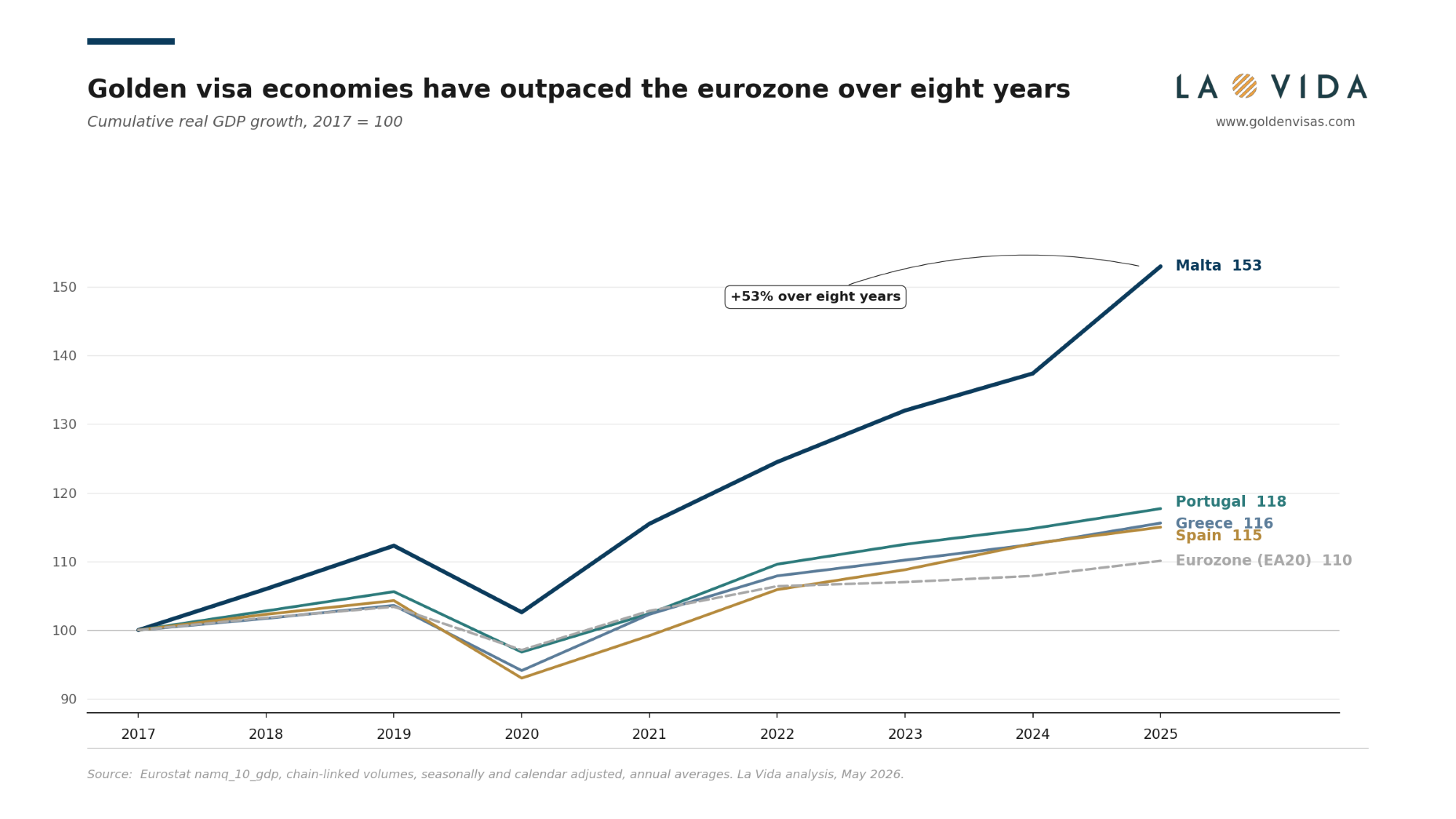

Real GDP in Malta, Portugal, Greece and Spain grew faster than the eurozone average from 2017 to 2025, according to research published today by investment migration firm La Vida. The four economies — all of which operated investment migration programmes throughout the period — outperformed the bloc on both aggregate and per-capita measures.
UXBRIDGE, U.K. - PennZone -- LONDON — The four European countries that ran continuous investment migration programmes from 2017 to 2025 each grew faster in real GDP terms than the eurozone average, new analysis from UK-based investment migration advisory firm La Vida has found.
Drawing on official Eurostat national accounts data, the research shows Malta's economy grew 53% in real terms over the eight years, Portugal by 17.7%, Greece by 15.6% and Spain by 15.0%. The eurozone aggregate over the same period grew 10.1%.
The pattern holds when adjusted for population. On a real GDP-per-capita basis, Malta grew by 22.4%, Greece by 19.3%, Portugal by 12.9% and Spain by 8.8%, against a eurozone figure of 7.7%.
More on The PennZone
Direct investment associated with the programmes themselves is too small to account for the difference. La Vida estimates the qualifying investment generated by the four programmes sits in the range of 0.025% to 0.25% of national GDP per year — an order of magnitude or more below the size of the growth gaps observed.
Paul Williams, CEO and Founder of La Vida, said:
"European economies are struggling for growth while government debt continues to climb. Governments and the EU need to take a closer look at the role residency and citizenship by investment can play in attracting productive wealth into their economies. Our analysis doesn't prove the programmes drove the growth gap. But the direction of the data is hard to ignore, and the contribution of wealthy migrants extends well beyond their initial qualifying investment — through businesses they start, taxes they pay over time, and capital they go on to deploy."
La Vida research identifies three non-exclusive readings of the data. Direct investment under the programmes contributed to growth through real estate, construction, government revenue and associated multiplier effects, but at a modest scale. A second channel runs through the entrepreneurial behaviour of programme beneficiaries themselves — investment beyond the qualifying minimum, business formation, employment creation and tax contributions over time. A third reflects shared characteristics across the four economies that drove growth independently of investment migration policy, including post-pandemic tourism recoveries, EU recovery fund allocations, services exports and recovery from the post-2012 sovereign debt crisis.
More on The PennZone
The European investment migration landscape has shifted markedly since the period analysed. Spain closed its programme in April 2025. Portugal removed real estate as a qualifying route in October 2023 shifting to Private Equity investment. Malta's citizenship-by-investment route was struck down by the European Court of Justice in April 2025, though its residence programme continues. Greece's programme remains open.
"The next eight years will not look like the last," Williams added. "Several of these programmes have been reformed or closed. But the debate about whether the underlying policy works — attracting wealth in exchange for residency or citizenship — is more relevant than ever. The UK has signalled interest in reintroducing an investor route. The US has its Trump Card proposal. Argentina has tendered for a new programme. Governments are looking at this again because debt levels and demographic pressures demand it."
The full analysis of GDP growth in golden visa countries, including methodology and source data, is available at www.goldenvisas.com/gdp-growth-in-eu-and-golden-visa-economies.
Drawing on official Eurostat national accounts data, the research shows Malta's economy grew 53% in real terms over the eight years, Portugal by 17.7%, Greece by 15.6% and Spain by 15.0%. The eurozone aggregate over the same period grew 10.1%.
The pattern holds when adjusted for population. On a real GDP-per-capita basis, Malta grew by 22.4%, Greece by 19.3%, Portugal by 12.9% and Spain by 8.8%, against a eurozone figure of 7.7%.
More on The PennZone
- CodesClue: A Trusted AI-Based Software Development Company for Global Businesses
- U.N. Committee Reiterates Forced Psychiatric Detention a Human Rights Violation; CCHR Calls on the U.S. to Implement Protections
- Valgar LLC Launches The Briefing Room: Education Leaders
- New Novel WINCE Takes Unflinching Aim at American Gun Culture and Masculinity
- New Research Puts the Cost of Enterprise Decision Delay at $630 Billion a Year Across the Global 2000
Direct investment associated with the programmes themselves is too small to account for the difference. La Vida estimates the qualifying investment generated by the four programmes sits in the range of 0.025% to 0.25% of national GDP per year — an order of magnitude or more below the size of the growth gaps observed.
Paul Williams, CEO and Founder of La Vida, said:
"European economies are struggling for growth while government debt continues to climb. Governments and the EU need to take a closer look at the role residency and citizenship by investment can play in attracting productive wealth into their economies. Our analysis doesn't prove the programmes drove the growth gap. But the direction of the data is hard to ignore, and the contribution of wealthy migrants extends well beyond their initial qualifying investment — through businesses they start, taxes they pay over time, and capital they go on to deploy."
La Vida research identifies three non-exclusive readings of the data. Direct investment under the programmes contributed to growth through real estate, construction, government revenue and associated multiplier effects, but at a modest scale. A second channel runs through the entrepreneurial behaviour of programme beneficiaries themselves — investment beyond the qualifying minimum, business formation, employment creation and tax contributions over time. A third reflects shared characteristics across the four economies that drove growth independently of investment migration policy, including post-pandemic tourism recoveries, EU recovery fund allocations, services exports and recovery from the post-2012 sovereign debt crisis.
More on The PennZone
- Easwe D10, C20, and C30: Lightweight Folding Electric Wheelchairs Built for Easier Travel
- Cover Story about Matthew Cossolotto – Author of Harness Your PromisePower -- Published in July 2026 Enterprise World Magazine
- Philadelphia Community Invited to Unite for Praise-A-Thon Summer Concert Benefiting Cobbs Creek
- Lineus Medical Signs Partnership Agreement with DIMA MedTech to Support Expansion into Italy
- New Research: Deterministic Decompilation of Hermes Bytecode Back to Readable JavaScript
The European investment migration landscape has shifted markedly since the period analysed. Spain closed its programme in April 2025. Portugal removed real estate as a qualifying route in October 2023 shifting to Private Equity investment. Malta's citizenship-by-investment route was struck down by the European Court of Justice in April 2025, though its residence programme continues. Greece's programme remains open.
"The next eight years will not look like the last," Williams added. "Several of these programmes have been reformed or closed. But the debate about whether the underlying policy works — attracting wealth in exchange for residency or citizenship — is more relevant than ever. The UK has signalled interest in reintroducing an investor route. The US has its Trump Card proposal. Argentina has tendered for a new programme. Governments are looking at this again because debt levels and demographic pressures demand it."
The full analysis of GDP growth in golden visa countries, including methodology and source data, is available at www.goldenvisas.com/gdp-growth-in-eu-and-golden-visa-economies.
Source: La Vida Europe Ltd
Filed Under: Business
0 Comments
Latest on The PennZone
- NextBoat's AI-Powered Marine Marketplace Gains Momentum as Record Growth Signals an Inflection Point for Investors (N Y S E American: NXB)
- ET&T Adds Senior Technical Voice Engineer to Strengthen Local Team
- Stepping Off the Grid: Savista Retreat Announces New Experiential Packages in Jaipur for Travellers
- Where Is Your Faith The Movie and Sountrack
- Bynn Intelligence Ranks #1 in NIST Child Online Safety Evaluation for Ages 13–16
- Rev-O-Box™ Launches Reversible Shipping Box That Instantly Becomes a Premium Gift Box
- Las Vegas Estate Firm Ghandi Deeter Blackham Offers Insight on Tony Hsieh's Contested $500 Million Will
- CCHR: Congressional Hearing Revives Lessons from MKULTRA Era – Why Past Psychiatric Human Rights Abuses Demand Vigilance Today
- Pacto Medical Wins Red Dot Design Concept Award 2026 for Slimshot® Compact Prefilled Syringe
- Heritage at Manalapan Introduces Luxury Single-Family Homes with Exceptional Value in One of Monmouth County's Most Desirable Locations
- Achugogo: Tale of the Spring Chaser Wins Inaugural TCCF Prize at Mifa Pitches, the Industry Market of the Annecy International Animation Film Festival
- Everything Policy Launches Madison, an AI Tool That Makes Legislation Readable for Students and Citizens
- Is the Market Missing One of the Most Undervalued Cybersecurity Companies on the Stock Market? Cycurion, Inc. (N A S D A Q: CYCU):
- Billion-Dollar Scale Global Technology Powerhouse Being Built with Expanding Government Contracts: Circle8 Group (N A S D A Q: CIRC)
- Nevada Boxing Hall of Fame Gears Up for Star-Studded 14th Annual Induction Gala Weekend
- MedSocially Expands Access to Healthcare Networking Platform
- New Thriller 'Counterframe' Explores the Hidden Vulnerabilities of Modern Society
- Award-Winning Heritage at South Brunswick Continues to Thrive as One of New Jersey's Premier New Home Communities
- Four Seasons Cleaners Debuts Santa Barbara County's First 24/7 Dry Cleaning Kiosk New self-service
- WhereTu Launches to Help Americans Build Successful Lives Abroad