Trending...
- From Speech Therapy to 300+ Episodes: Brother Marcus Turns His Voice Into a Movement Launching a 24/7 Inspiration Radio Network on Day 100 of the Year
- Mensa Brings National Board Game Competition to Northern Virginia April 16-19
- Porter's Day Care Empowers Philadelphia's Future Through 45+ Years of Excellence
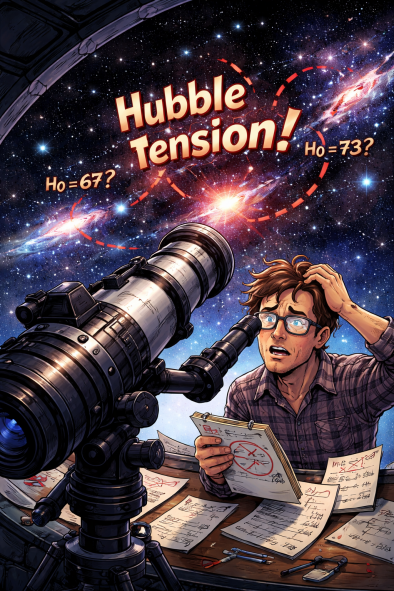
A newly published analysis proposes that the famous "Hubble tension" likely stems from an inference bias, occurring when standard General Relativity is applied to gravitational wave data that actually follows modified propagation.
HONOLULU - PennZone -- The long-standing "Hubble tension"—a discrepancy between early-universe measurements of cosmic expansion and late-universe distance measurements—remains one of modern cosmology's most debated puzzles. While the discrepancy is often interpreted as evidence for new physics in the universe's expansion history, a new study proposes a different possibility: part of the tension may arise from how distances are inferred.
In a recent implications analysis, independent researcher Aiden B. Smith examines whether gravitational-wave distance measurements—specifically from so-called "dark sirens"—could be subtly affected by assumptions about how gravitational waves propagate across cosmological distances.
More on The PennZone
Dark sirens are gravitational-wave events without confirmed electromagnetic counterparts. Their distances are inferred statistically using galaxy catalogues. Smith's analysis uses his previously identified propagation anomaly in the GWTC-3 dataset as a template and asks: if gravitational-wave amplitudes decay slightly differently than predicted by General Relativity, what effect would that have on cosmological inference?
The study finds that, under this hypothesis, applying standard General Relativity during distance compression can induce a shift in the inferred Hubble constant of approximately +2 to +5 km/s/Mpc—comparable in scale to the observed tension.
Importantly, the paper does not claim to resolve the Hubble tension. Instead, it demonstrates that gravitational-wave propagation assumptions are not mathematically neutral: if even modest deviations are present, they can bias late-time inferences.
The modified-propagation preference identified in the GWTC-3 dark-siren sample has been subjected to internal calibration and stress testing, including injection-based null simulations and robustness checks against selection and catalog perturbations. While the signal remains statistically unusual within the tested framework, confirming its physical origin will require independent replication and larger gravitational-wave samples from future observing runs.
More on The PennZone
If confirmed, the results would suggest that part of the Hubble tension may reflect a subtle distance-inference effect rather than a fundamental breakdown of the expansion model itself. If not, the analysis provides a quantitative diagnostic of where dark-siren cosmology may be vulnerable to systematic effects.
The full study and reproducibility materials are publicly available.
Data and Study Availability: While the work is currently in peer review, the full study is available to read on Smith's research journal at quasardipolephenomenon.org. All code and reproducibility artifacts associated with this analysis can be downloaded via Zenodo (DOI: 10.5281/zenodo.18635659) or accessed on GitHub.
In a recent implications analysis, independent researcher Aiden B. Smith examines whether gravitational-wave distance measurements—specifically from so-called "dark sirens"—could be subtly affected by assumptions about how gravitational waves propagate across cosmological distances.
More on The PennZone
- iVAM2-ST2110 to Simplify IP Transitions and Reduce Monitoring Complexity
- Americans Leave Behind or Discard 42% of Their Belongings When Moving Out for the First Time, Talker Research Finds
- Central Florida Luxury Real Estate Firm DANHOLM COLLECTION Partners with Luxury Presence to Expand Global Buyer Reach
- Advantage Marketing Launches 3-Minute Assessment to Help SMBs Diagnose and Fix Marketing Gaps
- RemodelCalculators.com Launches 15 Free Home Renovation Tools
Dark sirens are gravitational-wave events without confirmed electromagnetic counterparts. Their distances are inferred statistically using galaxy catalogues. Smith's analysis uses his previously identified propagation anomaly in the GWTC-3 dataset as a template and asks: if gravitational-wave amplitudes decay slightly differently than predicted by General Relativity, what effect would that have on cosmological inference?
The study finds that, under this hypothesis, applying standard General Relativity during distance compression can induce a shift in the inferred Hubble constant of approximately +2 to +5 km/s/Mpc—comparable in scale to the observed tension.
Importantly, the paper does not claim to resolve the Hubble tension. Instead, it demonstrates that gravitational-wave propagation assumptions are not mathematically neutral: if even modest deviations are present, they can bias late-time inferences.
The modified-propagation preference identified in the GWTC-3 dark-siren sample has been subjected to internal calibration and stress testing, including injection-based null simulations and robustness checks against selection and catalog perturbations. While the signal remains statistically unusual within the tested framework, confirming its physical origin will require independent replication and larger gravitational-wave samples from future observing runs.
More on The PennZone
- InterMountain Management Announces the Re-opening of Holiday Inn Express & Suites Alexandria
- CB Stuffer Expands New England Footprint with Launch at Common Man Roadside in Hooksett, NH
- Contracting Resources Group Named to the 2026 Inc. Regionals: Mid-Atlantic List
- Bishop Mary's WWDB 860 AM Show Nears Historic 250-Episode Milestone
- Dividend Stock Guru Unveils High Yield Dividend Stock Research Reports
If confirmed, the results would suggest that part of the Hubble tension may reflect a subtle distance-inference effect rather than a fundamental breakdown of the expansion model itself. If not, the analysis provides a quantitative diagnostic of where dark-siren cosmology may be vulnerable to systematic effects.
The full study and reproducibility materials are publicly available.
Data and Study Availability: While the work is currently in peer review, the full study is available to read on Smith's research journal at quasardipolephenomenon.org. All code and reproducibility artifacts associated with this analysis can be downloaded via Zenodo (DOI: 10.5281/zenodo.18635659) or accessed on GitHub.
Source: Aiden Blake Smith
0 Comments
Latest on The PennZone
- UK Buyers Purchase Luxury Home in Keene's Pointe, Windermere (Orlando, Florida)
- Instant IP Launches Rapid Takedown Service to Combat IP Theft, Deepfakes, and Copycat Websites
- From Speech Therapy to 300+ Episodes: Brother Marcus Turns His Voice Into a Movement Launching a 24/7 Inspiration Radio Network on Day 100 of the Year
- Su Che Publishing Announces New Children's Book Celebrating Vaisakhi Festival
- Best Companies Group Launches Free Best Places to Work in Chicago Program
- Permian Museum Adds Photos of Fossils Discovered on a Meteorite
- This Saturday: Open House for Manalapan's Newest Single Family Home Community
- Radarsign™ Awarded Sourcewell Contract Expanding Access to Traffic Safety Solutions
- MainConcept and NETINT Bring VPU Acceleration to Easy Video API
- Dr. Roxanne Contee Continues to Shine as a Powerhouse in Philadelphia Fashion, Media, and Community
- Larry R. Wasion's Jump Gate 2: Teleporter Expands the Time Travel Universe with High-Stakes Action and Ethical Dilemmas
- Bruce A. Rosenblat Releases A Pocket Full of Change, a Sharp, Thought-Provoking Book on Growth, Perspective, and Personal Change
- Marcus Boyd Announces Upcoming Children's Book The Royal World of Autism and Expands His Global Advocacy for Autism Awareness
- Former Philly Athletes Support Special Needs, Local Woman at Foundation Golf Classic
- Phuket Bike Week Rebrands as Hard Rock Cafe Phuket Bike Week Under Landmark 5-Year Partnership
- L2 Aviation Appoints Tony Bailey as President and Chief Operating Officer
- Pieter Bouterse Studio Founder to Retire After 40+ Years; Seeks Successor to Continue Legacy
- #WeAreGreekWarriors Opening Reception Packs the House
- Mensa Brings National Board Game Competition to Northern Virginia April 16-19
- Special Alert! Highly Undervalued Stock: $317M Revenue in 2025 for Telecom Leader IQSTEL, Inc. (N A S D A Q: IQST)